


How the Real Sumerians Looked Like
- Ryan Moorhen

- Jul 7, 2015
- 3 min read
How the Real Sumerians Looked Like | Part III of Obscuring the Sumerian Heritage
Upon analyzing hundreds of Sumerian artifacts, some that have been restored and others barely touched by the hands of curators, we decided to include only artifacts dated prior to 2400 BC. The Sumerian civilization, the original one, started its decline after 2400 BC. The Sumerians decline culminated in the next couple of centuries when by war, disease, and perhaps natural disasters, Sumerian city-states were abandoned. The focus of this part is to find out how Sumerians depicted themsleves in their art through different artifacts, so we are forced to leave the question of who retook Sumerian culture and revived it ca 2200 – 2000 BC, enough to say that for the most part, it wasn’t the original Sumerian population.
We mentioned before that many artifacts, especially those depicting Sumerians as they were, ended up with chopped heads, arms, legs or broken noses after excavation. The European curators then restored the artifacts with their view of how Sumerians looked like. This is the main reason we are now showing only artifacts that were documented in Iraq. Many artifacts remained unaltered in modern times before the looting of the Museum of Iraq following US military interventions in that country. Needless to say the military’s idea of preserving the invaluable heritage of the first civilization was not a priority; finding non-existent [nuclear] weapons of mass destruction was.
The first set of images shows some of the damaged artifacts.
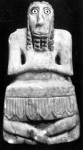
Khafaje, Early Dynasty II 2800-2600 BC
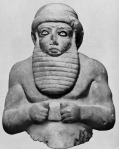
Uruk, 3000 BC
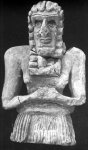
Khafaje, ED II
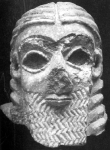
Agrab, ED II
The next set of images shows how the “real Sumerians” depicted themselves. We can see the facial features with some detail.
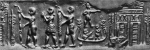
Sumerian Procession | Khafaje, Early Dynasty II
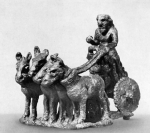
Charioteer | Tell Agrab, ED II
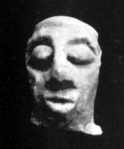
Male Head | Khafaje, ED II
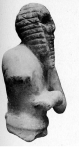
Tell Asmar, ED II
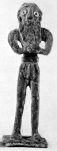
Tell Agrab, ED II
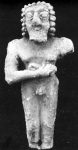
Early Dynasty II
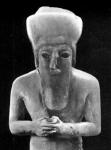
Tell Asmar, ED II
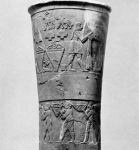
Vase zoomed in | Uruk, 3000 BC
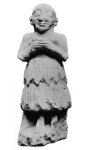
“Worshipper” | Khafaje, ED II
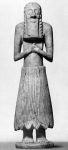
“Worshipper” | Tell Asmar, ED II
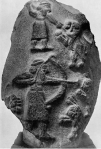
Stela, Uruk, 3000 BC
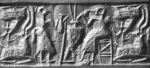
Khafaje, ED II
The following set of images represents Akkadian and Old Babylonian artifacts that show how they adopted Sumerian art and religion. However, we noticed how some of the artifacts focus on religion and not on the daily lives of the common citizens as Sumerians did. Some of the oldest Akkadian artifacts even look rudimentary. The point here is that popular websites and even some authors like to include Akkadian art and knowingly or otherwise label it as “Sumerian” when those artifacts are from later periods.
Compare the Akkadian procession to the Sumerian procession.
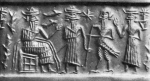
Akkadian [NOT Sumerian] | Tell Asmar, 2300 BC
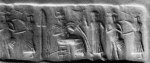
Akkadian Seal | Prisoner brought before EN.KI, Nippur, 2250 BC
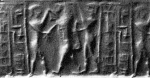
Akkadian | Nippur, 2250 BC
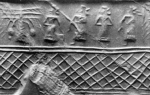
Akkadian Procession | Khafaje, 2300 BC
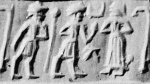
Old Babylonian | Nippur, 1800 BC
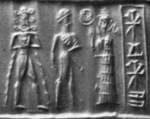
Old Babylonian | Ischali,1800 BC
By the time the Neo Assyrians inherited Sumerian religion and other elements of Sumerian culture ca. 800 BC, their artifacts show influence of other cultures such as the Egyptian. Again, our point is to distinguish later artifacts from “real Sumerian” artifacts because some publishers like this kind of misrepresentation.
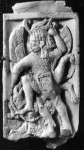
Neo Assyrian | Nimrud, 800 BC
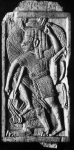
Neo Assyrian | Nimrud, 800 BC
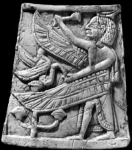
Neo Assyrian | Nimrud, 800 BC
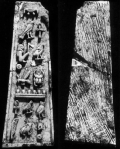
Egyptian Influence on Neo Assyrian Artifacts
We are here before images that bring us closer to an understanding of how the Sumerian really looked like. This is not conclusive by all means, but it lets the reader know that having a picture of how Sumerians looked like is not that difficult if we look in the right place. It also makes us ask the question, again, why do the Sumerians keep being misrepresented in favor of Akkadians, Assyrians, Babylonians, Egyptians, and the imagination of European curators? Why do some publishers keep labeling “Sumerian” something that is not, and never was Sumerian?
We are then on the next step towards finding clues to who were the Sumerians and where they came from. By J.J. Del Mar | KI.EN.GIR Part I | Part II | Part III
Part IV will deal with excavations of Sumerian human remains and other clues | Summer 2016


Comments