


The Legend of the three-legged crow and its possible origins
- Ryan Moorhen

- Nov 25, 2013
- 5 min read
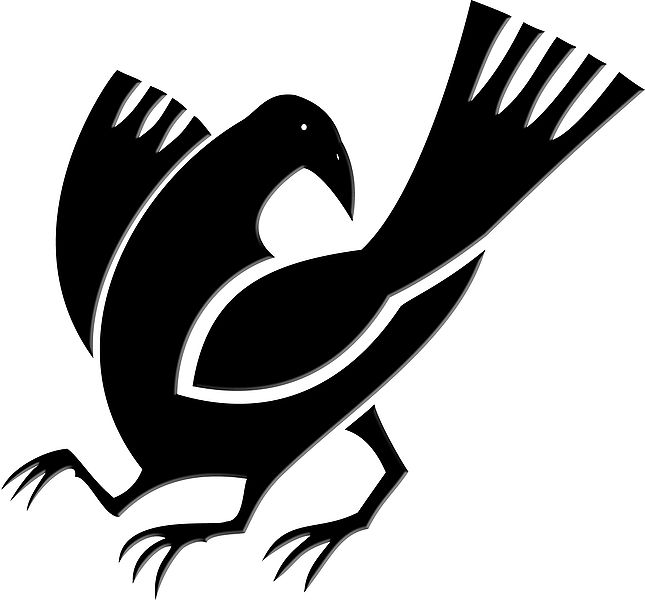
The three-legged (or tripedal) crow is a creature found in various mythologies and arts of Central Asia, East Asia, Egypt and North Africa. It is believed by many cultures to inhabit and represent the sun.
In Chinese mythology and culture, the three-legged crow is called the Sanzuwu and is present in many myths and is also mentioned in the Shanhaijing. The earliest known depiction of a three-legged crow appears in Neolithic pottery of the Yangshao culture, a Neolithic culture that existed extensively along the Yellow River in China dated from around 5000 BC to 3000 BC.
The culture is named after Yangshao, the first excavated representative village of this culture, which was discovered in 1921 in Henan Province by the Swedish archaeologist Johan Gunnar Andersson (1874–1960). The culture flourished mainly in the provinces of Henan, Shaanxi and Shanxi.
The Yangshao people mainly cultivated millet, but some settlements grew rice. They also grew vegetables like turnips, cabbage, yams and other vegetables. The Yangshao people domesticated chickens, ducks, pigs, dogs and cattle. Millet and rice was made into gruel for the morning while millet was made into dumplings. Meat, most of which was obtained by hunting or fishing, was eaten on only special occasions and rice was ground into flour to make cakes.
The Yangshao culture crafted pottery. Yangshao artisans created fine white, red, and black painted pottery with human facial, animal, and geometric designs. Unlike the later Longshan culture, the Yangshao culture did not use pottery wheels in pottery-making. Excavations found that children were buried in painted pottery jars.
The Sanzuwu is also of the Twelve Medallions that is used in the decoration of formal imperial garments in ancient China. A silk painting from the Western Han excavated at the Mawangdui archaeological site also depicts a Sanzuwu perched on a tree.
Mural from the Han Dynasty period found in Henan province depicting a three-legged crow.
The most popular depiction and myth of a Sanzuwu is that of a sun crow called the Yangwu, or more commonly referred to as the Jīnwū, or “golden crow”. Even though it is described as a crow or raven, it is usually colored red instead of black.
According to folklore, there were originally ten sun crows which settled in 10 separate suns. They perched on a red mulberry tree called the Fusang, literally meaning the Leaning Mulberry Tree, in the East at the foot of the Valley of the Sun. This mulberry tree was said to have many mouths opening from its branches.
Each day one of the sun crows would be rostered to travel around the world on a carriage, driven by Xihe the ‘mother’ of the suns. As soon as one sun crow returned, another one would set forth in its journey crossing the sky. According to Shanhaijing, the sun crows loved eating two sorts of mythical grasses of immortality, one called the Diri, or “ground sun”, and the other the Chunsheng, or “spring grow”.
The sun crows would often descend from heaven on to the earth and feast on these grasses, but Xihe did not like this thus she covered their eyes to prevent them from doing so. Folklore also held that, at around 2170 BC, all ten sun crows came out on the same day, causing the world to burn; Houyi the celestial archer saved the day by shooting down all but one of the sun crows. (See Mid-Autumn Festival for variants of this legend.)
In Chinese mythology, the Fènghuáng is commonly depicted as being two legged but there are some instances in art in which it has a three legged appearance. Xi Wangmu (Queen Mother of the West) is also said to have three green birds that gathered food for her and in Han-period religious art they were depicted has having three-legs. In the Yongtai Tomb dating to the Tang Dynasty Era, when the Cult of Xi Wangu flourished, the birds are also shown as being three-legged.
In Japanese mythology, this flying creature is a raven or a Jungle Crow called Yatagarasu, “eight-span crow”) and the appearance of the great bird is construed as evidence of the will of Heaven or divine intervention in human affairs.
Although Yatagarasu is mentioned in a number of places in the Shintō canon, the depictions are primarily seen on Edo wood art, dating back to the early 1800s wood-art era. Although not as celebrated current day, the crow is a mark of rebirth and rejuvenation; the animal that has historically cleaned up after great battles symbolized the renaissance after such tragedy.
Yatagarasu the Crow-God himself is symbolic specifically of guidance. This great crow was sent from heaven as a guide for Emperor Jimmu on his initial journey from the region which would become Kumano to what would become Yamato. It is generally accepted that Yatagarasu is an incarnation of Taketsunimi no mikoto, but none of the early surviving documentary records are quite so specific.
In more than one instance, Yatagarasu appears as a three legged crow in Kojiki.
Both the Japan Football Association and subsequently its administered teams such as the Japan national football team use the symbol of Yatagarasu in their emblems and badges respectively. The winner of the Emperor’s Cup is also given the honor of wearing the Itachi emblem the following season.
In Korean mythology, it is known as Samjok-o. During the period of the Koguryo Kingdom, the Samjok-o was a highly regarded symbol of power, thought superior to both the dragon and the Korean phoenix.
It was also the symbol of Goguryeo. According to Dan Gun Sae Gi Wu Suh Han, the 8th King of Old-Joseon Dynasty during BC 1987, saw Sam Jok O with each wing span of 90cm, flying inside his palace.
The three-legged crow was one of several emblems under consideration to replace the phoenix in the Korean seal of state when its revision was considered in 2008. The Samjok-o is considered a symbol of Goguryeo. The Samjok-o appears also in Jeonbuk Hyundai Motors’ current emblem.
In summary, we have seen that tripedal locomotion potentially formed a stage in our ownevolution, and that three-legged animals have been associated in myth and folklore withthe whole spectrum of human concerns.
Their attributes encompass the sun and divinepower (East Asian crow), the moon and earthly riches (Chinese toad), the male sexualprinciple (Mediterranean bull, East African initiation figurines and perhaps West Africanstallion), toys for children (Saharan mammal figurines), and even sacrifice and death (Mediterranean bull, Scandinavian ghost-horse, and West African funerary figurines).
While there are no doubt prototypes that have been overlooked and further associationsyet to be discovered, it should already be clear that the concept of the three-leggedcreature has fired the human imagination since the earliest times. Derided or neglected alltoo often, tripedalism has provided inspiration and symbolism that deserves wideracknowledgement and appreciation.
Comments