


The Sumerian King List
- Ryan Moorhen

- Feb 3, 2015
- 7 min read
Sumerian King List
The Sumerian King List is an ancient manuscript originally recorded in the Sumerian language, listing kings of Sumer (ancient southern Iraq) from Sumerian and neighboring dynasties, their supposed reign lengths, and the locations of “official” kingship. Kingship was believed to have been handed down by the gods, and could be transferred from one city to another, reflecting perceived hegemony in the region. Throughout its Bronze Age existence, the document evolved into a political tool. Its final and single attested version, dating to the Middle Bronze Age, aimed to legitimize Isin’s claims to hegemony when Isin was vying for dominance with Larsa and other neighboring city-states in southern Mesopotamia.
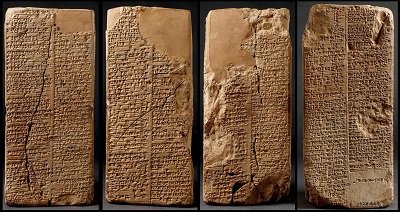
The Weld-Blundell Prism – The Sumerian kings list artifact, displaying all four sides.
Composition
The list blends prehistorical, presumably mythical predynastic rulers enjoying implausibly lengthy reigns with later, more plausibly historical dynasties. Although the primal kings are historically unattested, this does not preclude their possible correspondence with historical rulers who were later mythicized. Some Assyriologists view the predynastic kings as a later fictional addition. Only one ruler listed is known to be female: Kug-Bau “the (female) tavern-keeper”, who alone accounts for the Third Dynasty of Kish. The earliest listed ruler whose historicity has been archaeologically verified is Enmebaragesi of Kish, ca. 2600 BC. Reference to him and his successor, Aga of Kish in the Epic of Gilgamesh has led to speculation that Gilgamesh himself may have been a historical king of Uruk. Three dynasties are absent from the list: the Larsa dynasty, which vied for power with the (included) Isin dynasty during the Isin-Larsa period; and the two dynasties of Lagash, which respectively preceded and ensued the Akkadian Empire, when Lagash exercised considerable influence in the region. Lagash in particular is known directly from archaeological artifacts dating from ca. 2500 BC. The list is important to the chronology of the 3rd millennium BC. However, the fact that many of the dynasties listed reigned simultaneously from varying localities makes it difficult to reproduce a strict linear chronology.
Sources
The following extant ancient sources contain the Sumerian King List, or fragments:
Apkullu-list (W.20030,7)
Babyloniaca (Berossus)
Dynastic Chronicle (ABC 18) including copies, K 11261+ and K 12054
Kish Tablet (Scheil dynastic tablet)
UCBC 9-1819 (“California Tablet”)
WB 62
WB 444 (Weld-Blundell Prism)
The last two sources (WB) are a part of the “Weld-Blundell collection”, donated by Herbert Weld Blundell to the Ashmolean Museum. WB 62 is a small clay tablet, inscribed only on the obverse, unearthed from Larsa. It is the oldest dated source (c. 2000 BC) containing the list. WB 444 in contrast is a unique inscribed vertical prism, dated c. 1817 BC, although some scholars prefer c. 1827 BC. The Kish Tablet or Scheil dynastic tablet is an early 2nd millennium BC tablet which came into possession of Jean-Vincent Scheil; it only contains king list entries for four Sumerian cities. UCBC 9-1819 is a clay tablet housed in the collection of the Museum of Anthropology at the University of California. The tablet was inscribed during the reign of the Babylonian King Samsu-iluna, or slightly earlier, with a minimum date of 1712 BC. The Dynastic Chronicle (ABC 18) is a Babylonian king list written on six columns, beginning with entries for the antideluvian Sumerian rulers. K 11261+ is one of the copies of this chronicle, consisting of three joined Neo-Assyrian fragments discovered at the Library of Ashurbanipal. K 12054 is another of the Neo-Assyrian fragments from Uruk (c. 640 BC) but contains a variant form of the antediluvians on the list. The later Babylonian and Assyrian king lists, preserved the earliest portions of the list well into the 3rd century BC, when Berossus’ popularized fragments of the list in the Hellenic world. In 1960, the Apkullu-list (Tablet No. W.20030, 7) or “Uruk List of Kings and Sages” (ULKS) was discovered by German archaeologists at an ancient temple at Uruk. The list, dating to c. 165 BC, contains a series of kings, equivalent to the Sumerian antediluvians called “Apkullu”.
The list
Early dates are approximate, and are based on available archaeological data; for most pre-Akkadian rulers listed, this king list is itself the lone source of information. Beginning with Lugal-zage-si and the Third Dynasty of Uruk (which was defeated by Sargon of Akkad), a better understanding of how subsequent rulers fit into the chronology of the ancient Near East can be deduced. The short chronology is used here.
Antediluvian rulers
None of the following predynastic “antediluvian” rulers has been verified as historical via archaeological excavations, epigraphical inscriptions, or otherwise. It is possible that they correspond to the Early Bronze Age Jemdet Nasr period culture which ended approximately 2900 BC, immediately preceding the dynastys, if they were not purely mythological inventions.
The antediluvian reigns were measured in Sumerian numerical units known as (units of 3600), (units of 600), and (units of 60).
Ruler | Epithet | Length of reignApprox. dates | Comments |
8 sars (28,800 years)Between 35th and 30th c. BC | |||
10 sars (36,000 years) | |||
12 sars (43,200 years) | |||
8 sars (28,800 years) | |||
10 sars (36,000 years) | |||
8 sars (28,800 years) | |||
5 sars and 5 ners (21,000 years) | |||
5 sars and 1 ner (18,600 years) | |||
Excavations in Iraq have revealed evidence of localized flooding at Shuruppak (modern Tell Fara, Iraq) and various other Sumerian cities. A layer of riverine sediments, radiocarbon dated to ca. 2900 BC, interrupts the continuity of settlement, extending as far north as the city of Kish. Polychrome pottery from the Jemdet Nasr period (3000-2900 BC) was discovered immediately below the Shuruppak flood stratum. |
First Dynasty of Kish
Ruler | Epithet | Length of reignApprox. dates | Comments |
1200 yearshistoricity uncertain | names before Etana do not appear in any other known source, and their existence is archaeologically unverified | ||
960 years | |||
670 years | |||
420 years | |||
300 years | |||
840 years | |||
960 years | |||
840 years | |||
900 years | |||
(or | 600 years | ||
840 years | |||
720 years | |||
1500 years | |||
400 years | |||
660 years | |||
900 years | |||
( | 1200 years | ||
140 years | |||
305 years | |||
900 years | |||
1200 years | |||
900 yearsca. 2600 BC | the earliest ruler on the List confirmed independently from epigraphical evidence | ||
625 yearsca. 2600 BC | contemporary with |
First Dynasty of Uruk
Ruler | Epithet | Length of reignApprox. dates | Comments |
of | 324 yearsca. 27th | ||
420 years | |||
1200 years | |||
(Dumuzi) | ( | 100 yearsca. 2600 BC | |
126 yearsca. 2600 BC | contemporary with | ||
30 years | |||
15 years | |||
9 years | |||
8 years | |||
Mesh-he | 36 years | ||
Melem-ana | 6 years | ||
Lugal-kitun | 36 years |
First Dynasty of Ur
Ruler | Epithet | Length of reignApprox. dates | Comments |
80 yearsca. 26th century BC | |||
Mesh-ki-ang-Nuna | 36 years | ||
25 years | |||
36 years |
Dynasty of Awan
Ruler | Epithet | Length of reignApprox. dates | Comments |
Three kings of Awan | 356 yearsca. 26th century BC |
Second Dynasty of Kish
Ruler | Epithet | Length of reignApprox. dates | Comments |
Susuda | 201 yearsca. 26th century BC | ||
Dadasig | 81 years | ||
Mamagal | 360 years | ||
Kalbum | 195 years | ||
Tuge | 360 years | ||
Men-nuna | 180 years | ||
(Enbi-Ishtar) | 290 years | ||
Lugalngu | 360 years |
The First Dynasty of Lagash (ca. 2500 – ca. 2271 BC) is not mentioned in the King List, though it is well known from inscriptions.
Dynasty of Hamazi
Early Dynastic IIIb period (ca. 2500 – ca. 2271 BC)
Ruler | Epithet | Length of reignApprox. dates | Comments |
Hadanish | 360 yearsca. 2500 BC |
Second Dynasty of Uruk
Ruler | Epithet | Length of reignApprox. dates | Comments |
60 yearsca. 25th century BC | said to have conquered parts of Sumer; then | ||
Lugal-kinishe-dudu or Lugal-ure | 120 years | contemporary with | |
Argandea | 7 years |
Second Dynasty of Ur
Ruler | Epithet | Length of reignApprox. dates | Comments |
Nanni | 120 yearsca. 25th century BC | ||
Mesh-ki-ang-Nanna II | 48 years | ||
(?) | 2 years |
Dynasty of Adab
Ruler | Epithet | Length of reignApprox. dates | Comments |
90 yearsca. 25th century BC | said to have conquered all |
Dynasty of Mari
Ruler | Epithet | Length of reignApprox. dates | Comments |
Anbu | 30 yearsca. 25th century BC | ||
Anba | 17 years | ||
Bazi | 30 years | ||
Zizi of Mari | 20 years | ||
Limer | 30 years | ||
Sharrum-iter | 9 years |
Third Dynasty of Kish
Ruler | Epithet | Length of reignApprox. dates | Comments |
(Kubaba) | 100 yearsca. 25th century BC | the only known woman in the King List; said to have gained independence from |
Dynasty of Akshak
Ruler | Epithet | Length of reignApprox. dates | Comments |
Unzi | 30 yearsca. 25th – 24th century BC | ||
Undalulu | 6 years | ||
Urur | 6 years | ||
Puzur-Nirah | 20 years | contemporary with | |
Ishu-Il | 24 years | ||
Shu-Suen of Akshak | 7 years |
Fourth Dynasty of Kish
Ruler | Epithet | Length of reignApprox. dates | Comments |
Puzur-Suen | 25 yearsca. 24th – 23rd century BC | ||
400 (6?) yearsca. 2300 BC | according to the king list, | ||
Zimudar | 30 years | ||
Usi-watar | 7 years | ||
Eshtar-muti | 11 years | ||
Ishme-Shamash | 11 years | ||
(Shu-ilishu)* | (15 years)* | ||
Nanniya | 7 yearsca. 2303-2296 BC (short) |
Third Dynasty of Uruk
Ruler | Epithet | Length of reignApprox. dates | Comments |
25 yearsca. 2296-2271 BC ( | said to have defeated |
Dynasty of Akkad
Ruler | Epithet | Length of reignApprox. dates | Comments |
40 yearsca. 2270-2215 BC ( | defeated | ||
9 yearsca. 2214-2206 BC ( | |||
15 yearsca. 2205-2191 BC ( | |||
56 yearsca. 2190-2154 BC ( | |||
25 yearsca. 2153-2129 BC ( | |||
3 yearsca. 2128-2125 BC ( | |||
21 yearsca. 2125-2104 BC ( | |||
15 yearsca. 2104-2083 BC ( | Akkad falls to the |
Fourth Dynasty of Uruk
(Possibly rulers of lower Mesopotamia contemporary with the Dynasty of Akkad)
Ruler | Epithet | Length of reignApprox. dates | Comments |
Ur-ningin | 7 yearsca. 2091? – 2061? BC ( | ||
Ur-gigir | 6 years | ||
Kuda | 6 years | ||
Puzur-ili | 5 years | ||
Ur-Utu (or Lugal-melem) | ( | 25 years |
The 2nd Dynasty of Lagash (before ca. 2093-2046 BC (short)) is not mentioned in the King List, though it is well known from inscriptions.
Ruler | Epithet | Length of reignApprox. dates | Comments |
6 yearsca. 2147-2050 BC ( | |||
Zarlagab | 6 years | ||
(or Yarlagash) | 6 years | ||
(or Silulu) | 6 years | ||
Inimabakesh (or Duga) | 5 years | ||
Igeshaush (or Ilu-An) | 6 years | ||
3 years | |||
Ibate of Gutium | 3 years | ||
(or Yarlangab) | 3 years | ||
Kurum | 1 year | ||
Apilkin | 3 years | ||
La-erabum | 2 years | mace head inscription | |
Irarum | 2 years | ||
Ibranum | 1 year | ||
Hablum | 2 years | ||
Puzur-Suen | 7 years | ||
7 years | foundation inscription at | ||
(?) | 7 years | Si-um or Si-u? – foundation inscription at | |
40 days | defeated by |
Fifth Dynasty of Uruk
Ruler | Epithet | Length of reignApprox. dates | Comments |
conflicting dates (427 years / 26 years / 7 years)ca. 2055-2048 BC ( | defeats |
Third Dynasty of Ur
Ur III period “Sumerian Renaissance“ (ca. 2047 – 1940 BC (short))
Ruler | Epithet | Length of reignApprox. dates | Comments |
(Ur-Nammu) | 18 yearsca. 2047-2030 BC ( | defeats Nammahani of | |
46 yearsca. 2029-1982 BC ( | possible lunar/solar eclipse 2005 BC | ||
9 yearsca. 1981-1973 BC ( | |||
9 yearsca. 1972-1964 BC ( | |||
24 yearsca. 1963-1940 BC ( |
Independent Amorite states in lower Mesopotamia.
Dynasty of Isin
Middle Bronze Age IIsin–Larsa period
Ruler | Epithet | Length of reignApprox. dates | Comments |
33 yearsca. 1953-1730 BC ( | contemporary of | ||
20 years | |||
20 years | |||
20 years | |||
11 years | contemporary of | ||
( | 28 years | Contemporary of | |
21 years | |||
5 years | |||
8 years | He appointed his gardener, Enlil-Bani, substitute king and then suddenly died. | ||
24 years | contemporary of | ||
3 years | contemporary of | ||
4 years | |||
4 years | |||
11 years | |||
( | ( | (23 years)* |
* These epithets or names are not included in all versions of the king list.


Comments