


THEY TRIED to WIPE Us Out: ENKI, the Flood of 9800 BC, and the Memory of a Lost World
- Ryan Moorhen

- May 28
- 5 min read
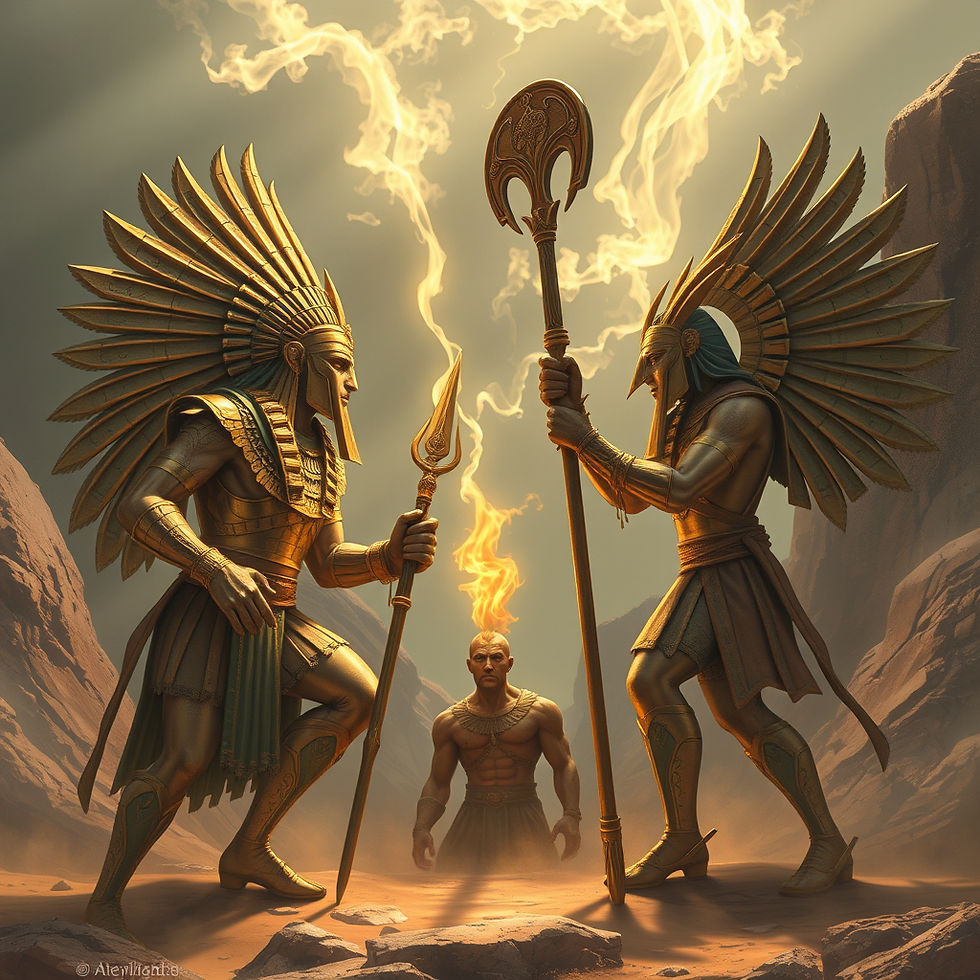
Across the ruins of ancient Mesopotamia, buried beneath shattered clay tablets and collapsed temple cities, there survives a story that refuses to disappear. It is a story of catastrophe, survival, rebellion among the gods, and a flood so devastating that entire civilizations vanished beneath rising waters. In our podcast episode, THEY TRIED to WIPE us out, ENKI and the Flood 9800BC, we explore these ancient traditions through the lens of Sumerian mythology, focusing especially on the enigmatic figure of Enki, one of the most important deities of the Sumerian world.
In Sumerian mythology, Enki was not merely a god of water. He represented intelligence, hidden knowledge, craftsmanship, and wisdom. His temples stood at the center of some of the earliest urban civilizations in human history. Ancient scribes described him as a protector of humanity, a being who often acted in opposition to harsher divine forces. While later civilizations would reinterpret these stories in different forms, the core narrative remained remarkably consistent: humanity faced destruction, and Enki intervened to preserve life.
The podcast builds its central narrative around the idea that the ancient flood traditions may preserve fragmented memories of real prehistoric events. One of the most discussed periods connected to this theory is around 9800 BC, a date often associated with the end of the last Ice Age and the dramatic climate disruptions that followed. During this era, sea levels rose rapidly as enormous ice sheets melted across the Northern Hemisphere. Entire coastal landscapes disappeared beneath expanding oceans. Regions that were once habitable plains became submerged forever.
Supporters of ancient catastrophe theories often connect these geological changes to flood myths found across the world. From Mesopotamia to India, from the Americas to the Mediterranean, cultures separated by vast distances preserved legends describing divine punishment, floods, darkness, destruction, and survivors carrying sacred knowledge into a new age. The episode suggests that these stories may not simply be symbolic myths, but distant echoes of humanity witnessing real environmental collapse.
In Mesopotamian tradition, one of the clearest flood accounts appears within the Epic of Gilgamesh. In this famous narrative, a man named Utnapishtim receives advance warning of an impending catastrophe and is instructed to preserve life through the construction of a great vessel. The similarities between this story and later biblical flood narratives have fascinated historians and theologians for generations. Yet the podcast emphasizes an even older layer of mythology, one rooted in Sumerian traditions involving Enki himself.
According to these traditions, higher divine authorities decided humanity had become problematic. Some versions claim humans had become too numerous and noisy. Others imply deeper conflicts involving control, knowledge, or cosmic order. Enki, however, sympathized with humanity. Instead of allowing complete annihilation, he secretly warned chosen survivors. This act of defiance transformed him into a complex figure: both a god within the divine hierarchy and a rebel against it.

One of the reasons these stories continue to fascinate modern audiences is their strange emotional realism. Ancient flood myths are not simple tales of destruction. They often contain fear, grief, moral ambiguity, and deep anxiety about survival. Entire worlds disappear. Cities collapse. Civilizations vanish. Survivors emerge traumatized into unfamiliar landscapes. The episode leans heavily into this atmosphere, portraying the flood not as fantasy, but as a collective memory passed through generations.
The connection to 9800 BC becomes even more intriguing when viewed alongside archaeological mysteries. Around this period, major climatic instability reshaped many regions of the world. Some researchers point toward Göbekli Tepe as evidence that sophisticated ritual cultures existed far earlier than previously believed. Massive stone enclosures, astronomical alignments, and complex symbolic carvings suggest organized societies operating near the end of the Ice Age. These discoveries have encouraged renewed speculation about whether humanity’s early history was more advanced and more turbulent than traditional models once assumed.
The podcast also explores the recurring theme of forbidden knowledge. In many ancient traditions, gods or divine beings share wisdom with humanity against the wishes of higher powers. Enki fits this archetype perfectly. He becomes a bringer of civilization itself, associated with writing, engineering, agriculture, water systems, and sacred sciences. In later mythological systems, similar figures appear repeatedly: culture-bringers who teach humanity skills that transform society.
This theme resonates because it reflects a larger human question: where did civilization truly begin? Mainstream archaeology traces gradual development through farming communities, trade systems, and early urbanization. Alternative theories, however, suggest that remnants of older forgotten cultures may have survived catastrophic transitions at the end of the Ice Age. The episode clearly leans toward this second interpretation, presenting the possibility that myths preserve distorted memories of real prehistoric upheavals.
Another major strength of the episode is its atmosphere. Rather than treating mythology as dry academic material, it presents ancient stories as living memories embedded within human consciousness. Mesopotamian gods become symbolic reflections of humanity’s deepest fears and ambitions. Flood narratives transform into warnings about fragility, survival, and cyclical collapse.
The figure of Enki himself remains especially compelling because he defies simple categorization. He is neither purely heroic nor entirely detached. He operates within divine politics, navigating conflict between obedience and compassion. This ambiguity gives the mythology unusual depth. Unlike later moralized religious systems where divine figures often represent absolute good or evil, Sumerian mythology portrays gods as powerful, emotional, unpredictable, and deeply intertwined with human destiny.
The episode also taps into the enduring fascination surrounding the Younger Dryas, a controversial but widely discussed climatic episode involving sudden cooling and environmental disruption near the end of the Ice Age. Some researchers have linked this period to comet impact theories, mass extinctions, widespread fires, and abrupt sea-level changes. While many of these interpretations remain debated, they continue to inspire intense interest because they offer possible real-world contexts for global catastrophe myths.
What makes flood stories so universal may be their connection to shared human vulnerability. Ancient communities lived close to rivers, coastlines, and unstable environments. Floods were not abstract fears. They were existential threats capable of erasing entire settlements overnight. Over thousands of years, memories of local disasters may have merged into larger mythological narratives describing world-ending destruction.
Yet the podcast argues that something more profound may be hidden beneath these traditions. It suggests that humanity may carry inherited cultural memories stretching far beyond recorded history. Whether one accepts this interpretation literally or symbolically, the emotional power of these myths remains undeniable.
Modern audiences are especially drawn to these stories because they exist at the intersection of mythology, archaeology, astronomy, and mystery. They invite listeners to question official timelines, reconsider ancient civilizations, and imagine worlds lost beneath oceans and deserts. The enduring popularity of Enki narratives demonstrates how deeply people continue to search for origins, forgotten histories, and explanations for humanity’s sudden rise into civilization.
In the end, the episode is less about proving a single historical theory and more about exploring humanity’s oldest memories. It asks whether myths are merely stories, or whether they contain encoded fragments of real events witnessed by ancient peoples thousands of years ago. Through the figure of Enki, it presents a vision of survival against annihilation, wisdom against destruction, and memory against oblivion.
Whether viewed as mythology, symbolic history, or speculative archaeology, the story of Enki and the great flood continues to captivate audiences because it touches something timeless within the human imagination. We are drawn to stories of collapse because they remind us how fragile civilizations truly are. We are drawn to stories of survival because they affirm resilience. And we are drawn to forgotten gods because they allow us to glimpse the mysterious origins of the world our ancestors struggled to understand.
Listen to the full episode here:THEY TRIED to WIPE us out, ENKI and the Flood 9800BC – Spotify Podcast Episode


Comments